SANA-WM: NVIDIA's Breakthrough World Model for Single-GPU Minute-Long Video Generation
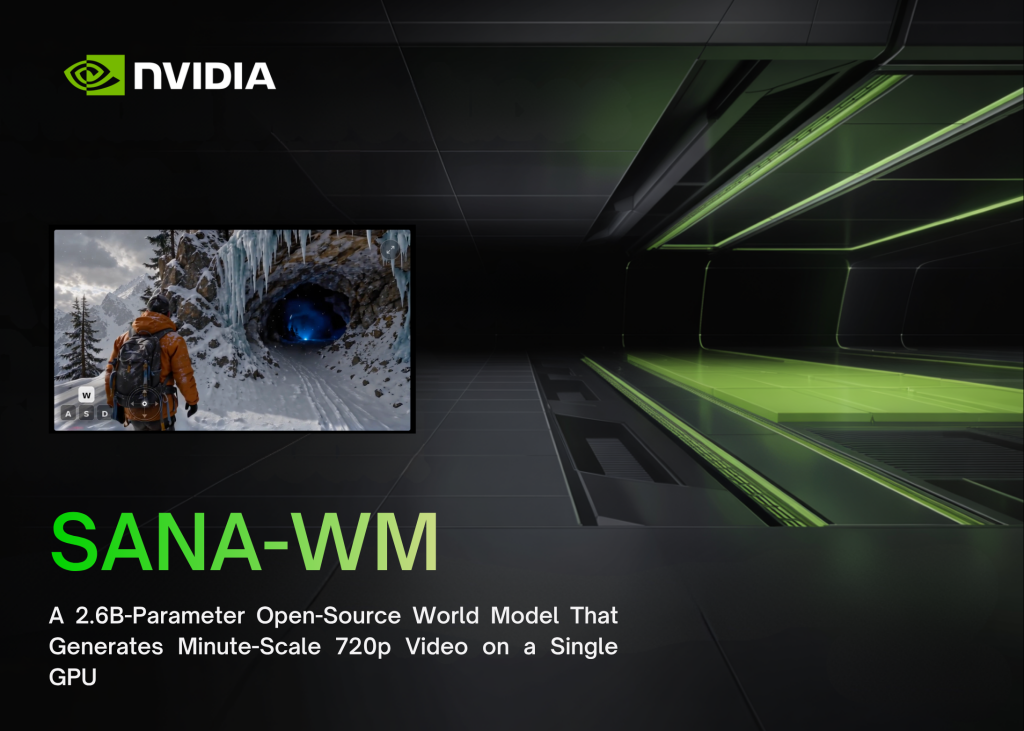
World models that generate realistic video from an initial image and action sequences are crucial for embodied AI, simulation, and robotics. However, producing minute-long, high-resolution video typically demands massive computational resources. NVIDIA's SANA-WM tackles this head-on: a 2.6-billion-parameter diffusion transformer that generates 720p video for 60 seconds on a single GPU. Below, we break down how it works, why it matters, and what makes it unique.
What is SANA-WM and Why Is It Significant?
SANA-WM is an open-source world model from NVIDIA, built on the SANA-Video codebase. It generates minute-long 720p video from a single starting image and metric-scale 6-DoF camera control, all on a single GPU — a feat previously requiring multi-GPU clusters. At 2.6 billion parameters, it uses a Diffusion Transformer (DiT) architecture optimized for long temporal sequences. Its significance lies in democratizing high-quality video generation for research: it runs on a single RTX 5090, making advanced world modeling accessible without expensive hardware. This opens doors for robotics training, simulation, and embodied AI where realistic, controllable video is essential.

How Does SANA-WM's Hybrid Attention Mechanism Work?
Standard softmax attention scales quadratically with sequence length, a bottleneck for 961 latent frames in a 60-second 720p clip. SANA-WM uses a hybrid approach: it interleaves 15 frame-wise Gated DeltaNet (GDN) blocks with 5 softmax attention blocks across 20 transformer layers. The GDN blocks maintain a constant-size recurrent state, scaling linearly with sequence length. Softmax blocks (at layers 3, 7, 11, 15, 19) provide exact long-range recall where recurrence alone falters. This balance cuts memory and compute for long videos while retaining quality. The design ensures stable training via an algebraic key-scaling of 1/√(D·S), where D is head dimension and S spatial tokens per frame, preventing NaN divergence seen with simpler scaling.
What Is Frame-Wise Gated DeltaNet and How Does It Improve on Past Methods?
Frame-wise Gated DeltaNet (GDN) is a linear attention variant tailored for video. Unlike the predecessor SANA-Video's cumulative ReLU attention (no decay, causing drift over long sequences), GDN introduces a decay gate γ that down-weights stale frames and a delta-rule correction that updates only the residual between the target and current state prediction. Processing one latent frame per step, it keeps a constant-size D×D recurrent state regardless of video length. This prevents the unbounded accumulation of past information, enabling stable minute-scale generation. The algebraic key-scaling 1/√(D·S) ensures the transition matrix's spectral norm stays bounded, eliminating NaN events that plagued earlier scaling methods (L2 normalization or no scaling).
How Does SANA-WM Achieve Precise Camera Control?
SANA-WM incorporates a dual-branch camera control mechanism for 6-DoF (six degrees of freedom) camera trajectories. One branch processes the camera parameters (position, orientation) via a dedicated encoder, while the main backbone handles video generation. The camera embedding is injected into the transformer blocks, allowing the model to condition generation on exact camera motion. This enables continuous, metric-scale control — pan, tilt, zoom, and translation — over the entire 60-second clip. The twin branches ensure that camera actions influence the scene without interfering with the spatiotemporal latent representation, resulting in coherent video that follows specified camera paths.
What Inference Variants Does SANA-WM Support for Single-GPU Deployment?
SANA-WM offers three single-GPU inference modes:
• Bidirectional generator: for high-quality offline synthesis, processing all frames simultaneously.
• Chunk-causal autoregressive generator: sequential rollout, suitable for real-time or interactive settings.
• Few-step distilled autoregressive generator: optimized for speed — denoises a 60-second 720p clip in just 34 seconds on a single RTX 5090 with NVFP4 quantization. The distilled variant uses fewer diffusion steps while maintaining fidelity, making it ideal for rapid prototyping and deployment. All variants run on one GPU, drastically lowering the barrier for world model research.
How Was SANA-WM Trained and What Makes It Stable?
Training SANA-WM required stabilizing the novel GDN recurrence. The team introduced algebraic key-scaling: keys are scaled by 1/√(D·S) (D: head dimension, S: spatial tokens per frame). This bounds the spectral norm of the transition matrix, preventing the NaN divergence that occurred with standard L2 normalization (1/√D) or no scaling at all — which triggered NaN at steps 16 and 1 respectively. The model was trained from scratch on large-scale video data, using the SANA-Video codebase. The hybrid attention (15 GDN + 5 softmax blocks) balances efficiency and recall. The result is a robust world model that generates high-resolution video without training instabilities.
What Are the Practical Implications of SANA-WM for AI Research?
SANA-WM dramatically lowers the compute requirements for world modeling. With single-GPU inference, researchers can generate minute-long, 720p controllable video without clusters. This advances embodied AI, robotics training, and simulation — tasks that need realistic, long-horizon video for policy learning or scenario testing. The open-source release (via NVlabs/Sana on GitHub) encourages community adoption and extension. Potential applications include autonomous vehicle simulation, robot manipulation training, and virtual environment generation. By making high-quality world models affordable, SANA-WM accelerates progress in AI systems that must understand and predict visual dynamics over extended periods.
Related Articles
- How to Test Intel's Cache Aware Scheduling on Your Linux System
- SPIFFE Identity Standard Becomes Urgent Fix as Autonomous AI Agents Outpace Traditional Security
- PCIe 5.0 SSDs: Who Actually Needs Them? A Practical Decision Guide
- SPIFFE Identity Standard Becomes Critical for Securing Autonomous AI Agents
- Asus ROG NUC 16: A Compact Powerhouse Redefining Mini Gaming PCs
- AI Infrastructure Revolution: Cost Per Token Emerges as the True Measure of Profitability
- Lenovo’s Flagship RTX 5090 Gaming Tower Slashes Price by Over $2,000 in Limited-Time Deal
- Rust 1.97 Raises Minimum GPU Requirements for CUDA Targets