A Galaxy in Transition: Hubble Captures the Lenticular NGC 1266
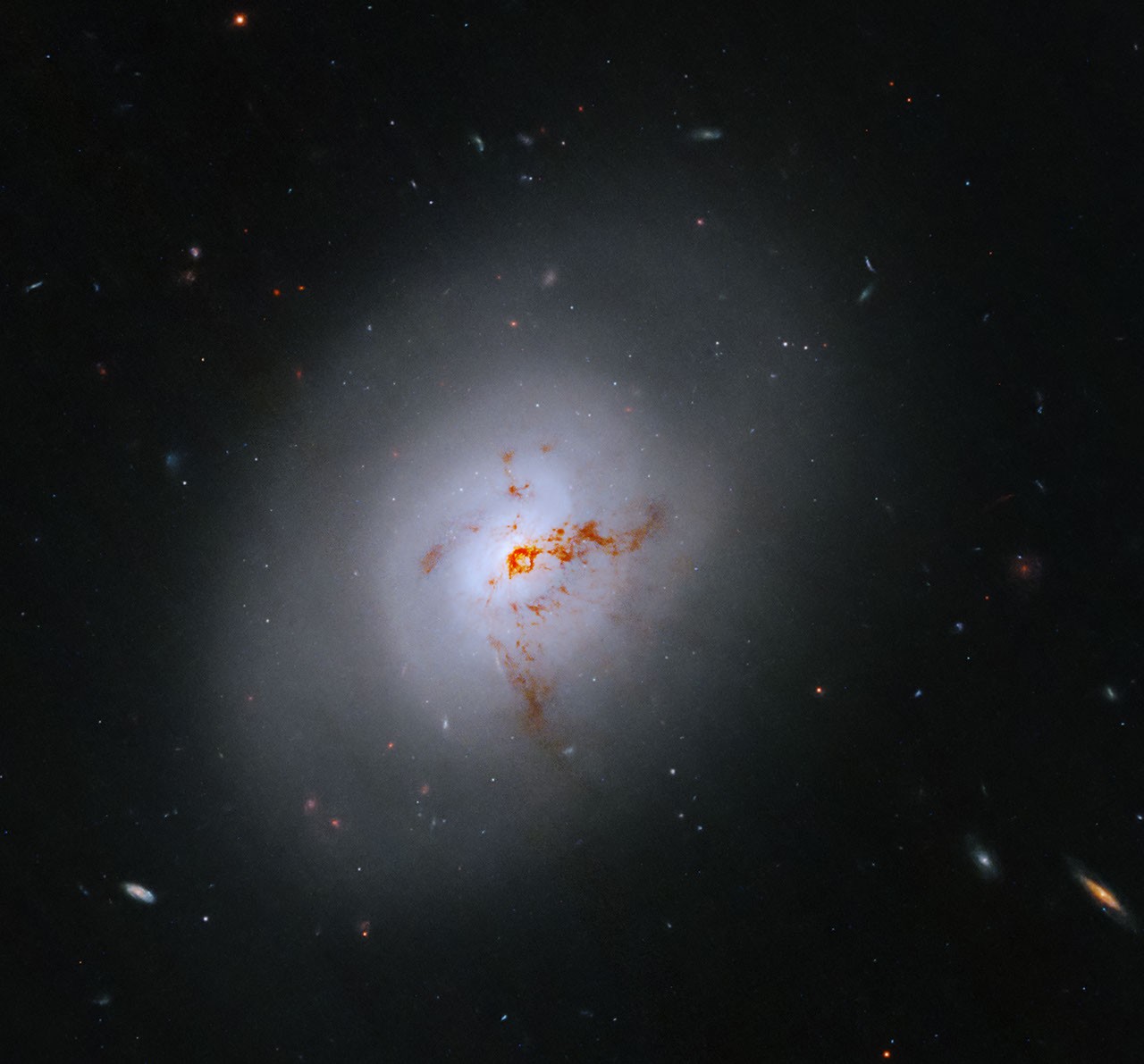
The NASA/ESA Hubble Space Telescope has delivered a striking new image of NGC 1266, a galaxy that defies easy categorization. Located roughly 100 million light-years away in the constellation Eridanus (the Celestial River), this object presents a brilliant core and a disk that faintly suggests spiral structure—yet it lacks the sweeping arms typical of spiral galaxies. Dark, reddish-brown lanes of dust partially veil its face, while distant galaxies in red, blue, and orange hues dot the background, adding depth to the cosmic scene.
What Is a Lenticular Galaxy?
Astronomers classify NGC 1266 as a lenticular galaxy—a type that serves as an evolutionary bridge between spirals and ellipticals. Lenticulars are lens-shaped, featuring a prominent central bulge and a flattened disk reminiscent of spiral galaxies. However, they lack the prominent spiral arms and contain little to no ongoing star formation, a trait they share with elliptical galaxies. Their structure suggests they may have once been spirals that exhausted or lost their gas, preventing further star birth.
Key features of lenticular galaxies include:
- A bright, round bulge composed mostly of old stars.
- A thin, rotating disk of stars and dust, but no spiral arm pattern.
- Very little interstellar gas or dust, leading to low star-formation rates.
- A transitional position in the Hubble classification scheme (S0).
NGC 1266: A Rare Post-Starburst Galaxy
While the lenticular morphology is intriguing, NGC 1266’s most remarkable trait is its status as a post-starburst galaxy. Only about 1% of galaxies in the local universe fall into this category. Post-starburst galaxies have experienced an intense, short-lived burst of star formation in the recent past, but have since largely shut down star birth. They contain a youthful population of stars yet show almost no star-forming regions today.
This makes NGC 1266 a cosmic laboratory for understanding how galaxies evolve from active, star-forming systems into quiet, quiescent ones like ellipticals. The galaxy is caught in a brief transition phase—lasting perhaps a few hundred million years—before it settles into a more dormant state.
The Role of a Minor Merger
Astronomers believe that NGC 1266 underwent a minor merger with a smaller companion galaxy roughly 500 million years ago. This event would have triggered a powerful wave of star formation and funneled gas toward the galaxy’s center. The influx of gas had two major effects:
- Enhanced central bulge mass: New stars formed rapidly in the core, thickening the bulge.
- Active galactic nucleus (AGN): The supermassive black hole at the center of NGC 1266 accreted the incoming gas, becoming highly active and emitting intense radiation across the electromagnetic spectrum.
Today, this AGN may still be active, though at a lower level. The merger also likely stripped away much of the galaxy’s remaining gas, explaining why star formation has now ceased.
Implications for Galaxy Evolution
Studying galaxies like NGC 1266 helps astronomers piece together the life cycle of galaxies. The transition from a gas-rich spiral to a gas-poor lenticular or elliptical is poorly understood, but post-starburst galaxies provide a snapshot of that process. Key insights include:
- Mergers as catalysts: Minor mergers can ignite bursts of star formation without completely disrupting the galaxy’s structure.
- Black hole feedback: An active nucleus can heat or expel gas, quenching further star formation—a process seen in NGC 1266.
- Rarity of the phase: The short duration of the post-starburst stage means we are seeing a fleeting moment in the galaxy’s history.
Future observations with telescopes like the James Webb Space Telescope will probe the dusty regions and faint gas in NGC 1266, refining our models of galactic transformation.
Image Credit: NASA, ESA, K. Alatalo (STScI); Image Processing: G. Kober (NASA/Catholic University of America)
Related Articles
- How Coffee Reshapes Your Gut and Brain: A Practical Guide to Harnessing Its Benefits
- Massive Bering Strait Dam Proposed to Halt Catastrophic Ocean Current Collapse
- 10 Startling Facts About Greenland's Melting Ice and the Methane Time Bomb Beneath the Seafloor
- Shaping the Invisible: Ana Inês Inácio’s Path to RF Sensor Innovation
- Your Questions Answered: VS Code Python Environments Extension April 2026 Update
- Samsung App Challenges the Gesture Navigation Trend: A Q&A
- Hidden Chemical Signatures Reveal Alien Life: New Detection Method Shocks Astrobiology Community
- Wildfire Erupts in Chernobyl Exclusion Zone After Drone Incident