Mastering List Flattening in Python: A Step-by-Step Tutorial
Introduction
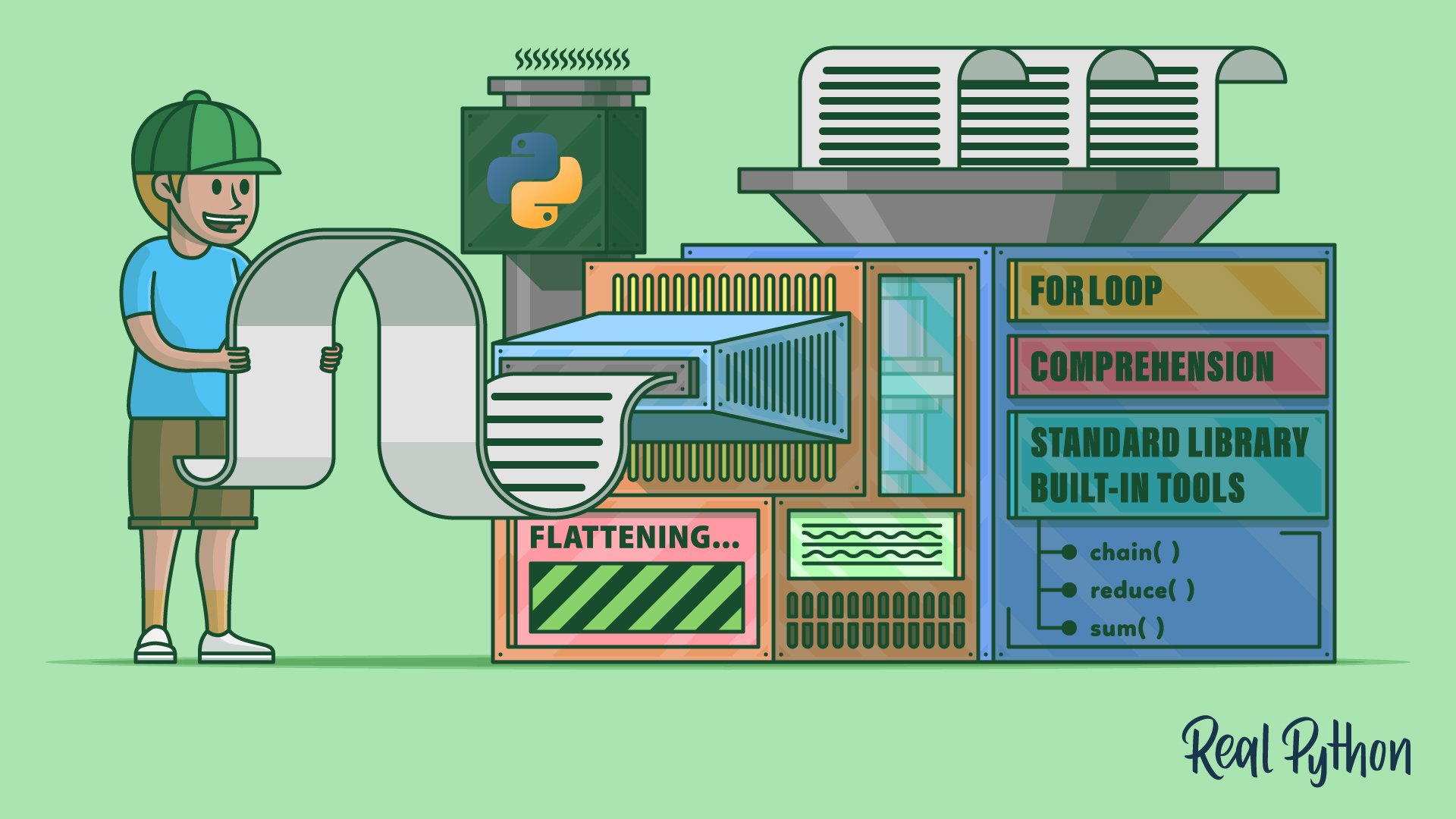
Working with nested lists is a common task in Python, especially when dealing with data from sources like matrices, JSON structures, or API responses. Flattening such lists—turning a multi-dimensional list into a single, one-dimensional list—can simplify iteration, storage, and analysis. This step-by-step guide will walk you through multiple methods to flatten lists of lists, from simple comprehensions to robust recursion and library functions. By the end, you'll have a toolkit to handle any nesting depth efficiently.
What You Need
- Python 3.6 or newer installed on your system
- Basic familiarity with Python lists and loops
- A code editor or interactive Python environment (like IDLE, VS Code, or Jupyter)
- Optional: libraries like
itertools(built-in) ornumpyfor advanced cases
Step-by-Step Instructions
Step 1: Understand Your Nested List Structure
Before flattening, examine the depth and regularity of your nested list. For example, a matrix (list of lists) with equal-length rows is easier to flatten than an irregular nest. Here's a typical example:
nested = [[1, 2, 3], [4, 5, 6], [7, 8, 9]]This is a list of three sublists. Deeper nesting might look like [[[1, 2], [3, 4]], [[5, 6]]]. Knowing the structure helps choose the right method.
Step 2: Use a Simple List Comprehension (Single-Level)
For a list of lists (not deeper), a list comprehension with two for clauses is the most Pythonic and readable approach:
flattened = [item for sublist in nested for item in sublist]This iterates over each sublist and then each item within, collecting them into a single list. Works for any number of sublists. Try it on nested above to get [1, 2, 3, 4, 5, 6, 7, 8, 9].
Step 3: Leverage itertools.chain for Memory Efficiency
Python's itertools.chain can flatten nested iterables without creating intermediate lists—great for large data:
from itertools import chain
flattened = list(chain.from_iterable(nested))
chain.from_iterable takes an iterable of iterables and yields items one by one. Wrapping in list() materializes the result. This method is slightly faster than list comprehensions for big lists.
Step 4: Handle Deeper Nesting with Recursion
When lists contain sublists at arbitrary depth (e.g., [[1, [2, 3]], 4]), a recursive function is needed:
def flatten_deep(lst):
    result = []
    for item in lst:
        if isinstance(item, list):
            result.extend(flatten_deep(item))
        else:
            result.append(item)
    return result
This checks each element: if it's a list, call the function recursively; otherwise, append the item. Test with:
deep_list = [[1, [2, 3]], [4, [5, [6]]]]
print(flatten_deep(deep_list))  # [1, 2, 3, 4, 5, 6]
Step 5: Use Libraries for Advanced Cases
For extremely deep or irregular nesting, specialized libraries can simplify. Two popular options:
- NumPy: Use
numpy.flatten()on a numpy array (all elements must be the same type). - more-itertools: Install via
pip install more-itertoolsand usecollapseto flatten any depth.
Example with NumPy:
import numpy as np
arr = np.array(nested)  # assumes equal-length sublists
flattened = arr.flatten().tolist()
Tips for Success
- Choose the right tool: For simple list-of-lists, list comprehension or
itertools.chainare best. For multi-level nesting, recursion is reliable. For performance with huge data, consider generators. - Beware of mixed types: Recursion expects all non-list items to be numbers or strings—if your list contains dictionaries or custom objects, you'll need to adapt the
isinstancecheck. - Memory considerations: Recursion can hit Python's recursion limit (~1000). If you know depth is large, use an iterative stack-based approach.
- Test edge cases: Empty lists, lists with only one element, or lists containing a mix of integers and lists should be handled gracefully.
Related Articles
- 10 Surprising Truths About Programming Evolution That Nobody Talks About
- Mastering MCP Tool Governance in .NET: A Q&A on the Agent Governance Toolkit
- 10 Things You Need to Know About Cloudflare Giving AI Agents the Keys to the Cloud
- How to Enjoy 'Breaking the Code' at Central Square Theater: A Step-by-Step Guide to Experiencing Alan Turing's Story
- AI Agent Coordination Crisis: Intuit Engineers Reveal the Hardest Problem in Modern Engineering
- How to Join the Python Security Response Team: A Step-by-Step Guide
- Mastering Structured-Prompt-Driven Development: A Q&A Guide
- 8 Key Updates to the Python Security Response Team (And How to Join)