Stargazing from Orbit: Understanding Airglow and the Milky Way from the ISS
On April 13, 2026, NASA astronaut Chris Williams captured a breathtaking image from a SpaceX Dragon spacecraft docked to the International Space Station. The photo shows the Milky Way rising above Earth's atmospheric glow, a phenomenon known as airglow. This Q&A explores what was seen, how airglow works, and why space provides such pristine views of our galaxy.
What did NASA astronaut Chris Williams capture from the ISS in April 2026?
While aboard a SpaceX Dragon docked to the International Space Station, astronaut Chris Williams photographed the Milky Way as it rose above Earth's horizon. The image, taken on April 13, 2026, stands out because it simultaneously shows the galaxy's dense star clouds and a faint, colorful glow enveloping the planet. This glow, called airglow, appears as a diffuse band of light just above the Earth's limb. The Milky Way itself shines brilliantly because the ISS orbits above most atmospheric interference, offering an unobstructed view of the galaxy's core.
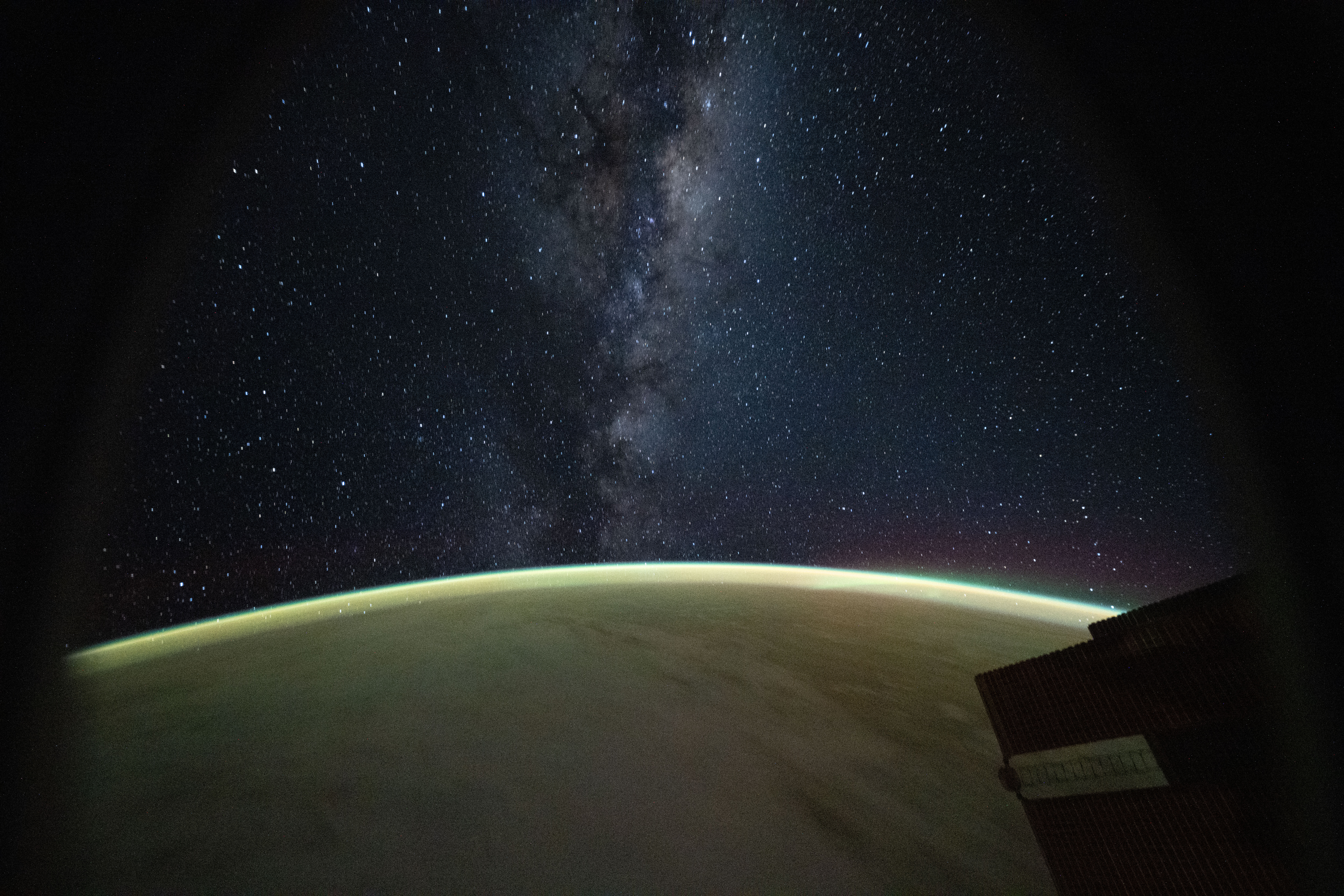
What is airglow and how does it occur?
Airglow is the natural emission of light from Earth's upper atmosphere, visible even on the night side. It happens when atoms and molecules in the upper atmosphere absorb energy from sunlight during the day and release it at night as photons. There are two main mechanisms: first, atoms and molecules can become excited by solar radiation and then relax by emitting a photon. Second, ions that were created by sunlight can collide with free electrons; when the electron is captured, the excess energy is released as light. Both processes produce airglow, which appears as a faint, often green or red glow above the horizon. Unlike the stark darkness of space, airglow provides a subtle backdrop that can sometimes interfere with astronomical observations from orbit.
How does airglow differ from auroras?
Although airglow and auroras both create colorful displays in the sky, their origins are distinct. Auroras are driven by high-energy particles from the solar wind that collide with Earth's magnetic field and atmosphere near the poles. In contrast, airglow is powered by ordinary solar radiation—the same sunlight that heats the Earth during the day. Airglow occurs globally across all latitudes, not just near the poles, and is a constant feature of the upper atmosphere. While auroras are often vibrant and dynamic, airglow is much fainter and more uniform. Both phenomena involve atoms emitting photons, but the energy source differs: auroras rely on energetic particles, whereas airglow uses everyday UV sunlight.
Why is the Milky Way more visible from the International Space Station?
From the ground, the Milky Way is often obscured by light pollution, atmospheric haze, and scattered sunlight. The International Space Station orbits roughly 400 kilometers above Earth, placing it well above the bulk of the atmosphere. Without airglow, the sky from the ISS would be completely black, making stars and the Milky Way exceptionally crisp. Additionally, the ISS experiences a sunrise or sunset every 90 minutes, so astronauts frequently have opportunities to observe the galaxy in near-perfect darkness. Chris Williams's photo from the SpaceX Dragon benefited from this high vantage point, combined with a clear view of the Milky Way's core rising over the planet's airglow layer.
What role did the SpaceX Dragon play in capturing this image?
The SpaceX Dragon spacecraft provided a crucial observation platform for Chris Williams's photo. Docked to the International Space Station, the Dragon's Cupola-like window or other vantage points allowed an unobstructed view of Earth's limb and the Milky Way. The Dragon is typically used for crew transport, but its large windows are also ideal for Earth observation and astrophotography. Being detached from the main station's structure may have reduced vibrations and reflections, yielding a sharper image. Moreover, the timing of the photo coincided with the station's orbital night, when the Dragon was positioned to see the Milky Way rising. This image is a testament to how commercial spacecraft like the Dragon expand the capabilities of space-based photography.
How does the solar wind relate to airglow and auroras?
The solar wind is a stream of charged particles emitted by the Sun. These particles are the primary driver of auroras, as they interact with Earth's magnetic field and excite atoms in the polar regions. Airglow, however, is not caused by the solar wind but by direct solar radiation (ultraviolet and visible light) absorbed by the upper atmosphere. In both cases, atoms and molecules release photons when they return to a lower energy state. Think of auroras as a chaotic, energetic event triggered by solar storms, while airglow is a quiet, constant glow fueled by ordinary sunlight. Chris Williams's image captures airglow in its steady state, contrasting with the more dramatic but sporadic auroras seen from lower orbits.
Related Articles
- Astronomers Unveil Massive Halo Surrounding Sombrero Galaxy in Striking New Image
- Reducing the Genetic Alphabet: Can Life Do With Fewer Than 20 Amino Acids?
- 10 Ways Amazon WorkSpaces Empowers AI Agents to Supercharge Your Enterprise Workflows
- 10 Must-Know Skywatching Events in May 2026: A Complete Guide
- Mastering Coding Agents: The Power of Harness Engineering
- Artemis 3 Delay: Will NASA's Lunar Landing Slip to 2028 or Beyond?
- How to Monitor Astronaut Joint Health Using Noninvasive Ultrasound During Space Missions
- Navigating Climate Change: A Guide to Understanding and Mitigating Food Insecurity in an Overheating World