Astronaut Captures Stunning Airglow and Milky Way from ISS
A Breathtaking View from Orbit
On April 13, 2026, NASA astronaut Chris Williams was aboard a SpaceX Dragon spacecraft docked to the International Space Station (ISS) when he captured a remarkable photograph. The image shows the Milky Way rising above Earth's atmospheric glow, a phenomenon known as airglow. This stunning view reminds us of the unique vantage point astronauts have while orbiting our planet. The photo, credited to NASA and Williams, offers both beauty and scientific insight into the processes occurring in Earth's upper atmosphere.
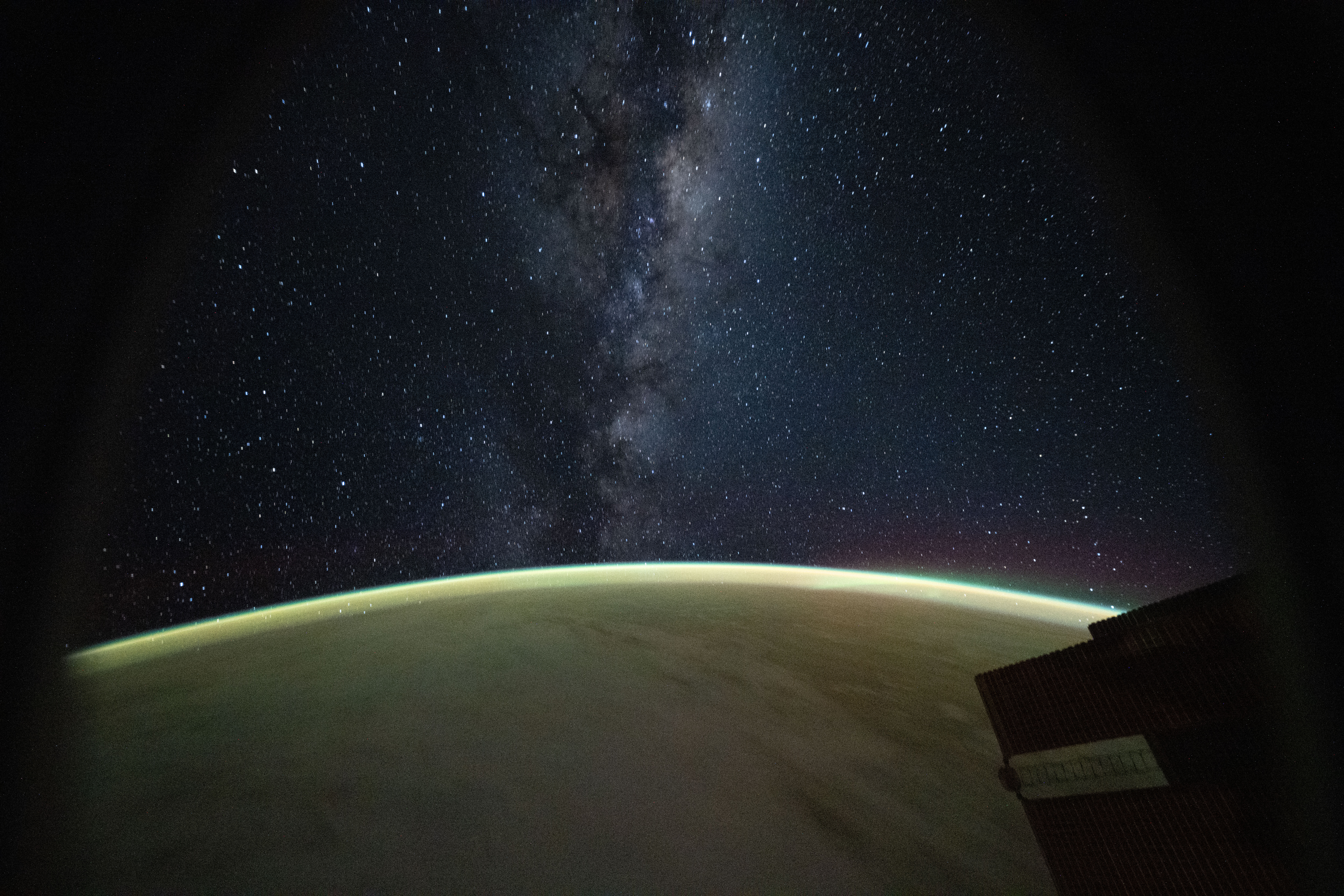
The Image: A Celestial Horizon
Williams’s photograph reveals the silvery arc of the Milky Way stretching across the sky, with Earth’s curved limb aglow in a soft turquoise and orange hue. This ethereal light is not from city lights or the Sun directly, but from a natural emission called airglow. The image was taken from the Dragon capsule while it was docked to the ISS, highlighting the seamless collaboration between NASA and commercial partners like SpaceX in making such observations possible.
What Is Airglow?
Airglow is a faint emission of light from Earth’s upper atmosphere, typically occurring at altitudes between 80 and 300 kilometers (50 to 190 miles). It happens when atoms and molecules, excited by sunlight, release energy in the form of photons (particles of light).
Two Main Mechanisms
- Excitation by sunlight: Molecules such as oxygen, nitrogen, and sodium absorb energy from the Sun's ultraviolet radiation during the day. At night, they shed this excess energy by emitting light, creating the glow we see.
- Ionization followed by recombination: Some atoms become ionized (losing an electron) after absorbing sunlight. When they later recombine with a free electron, the energy is released as a photon. This process also contributes to airglow.
In both cases, the atoms and molecules are simply returning to a lower energy state, and the emitted light appears as a diffuse glow around Earth. The phenomenon is present in several colors, including green, red, and blue, depending on the altitude and the specific chemicals involved.
Airglow vs. Auroras: Key Differences
While airglow and the aurora borealis (northern lights) might look similar from space, their origins are distinct.
| Feature | Airglow | Aurora |
|---|---|---|
| Energy source | Everyday solar radiation | High-energy particles from the solar wind |
| Primary driver | Sunlight absorption and release | Collisions with Earth’s magnetosphere |
| Location | Global, constant but faint | Polar regions, stronger and more dynamic |
As noted by NASA, airglow is energized by ordinary solar radiation, whereas auroras are powered by energetic particles from space that collide with the atmosphere. Airglow is also present every night, even if invisible to the naked eye from the ground, while auroras are sporadic and localized.
Why the ISS Is an Ideal Platform
The International Space Station orbits at an altitude of approximately 400 kilometers (250 miles), placing it right in the zone where airglow is strongest. Astronauts like Chris Williams can observe and photograph this phenomenon without the distorting effects of Earth’s lower atmosphere.
The Role of SpaceX Dragon
The image was taken from a SpaceX Dragon capsule, demonstrating how commercial crew vehicles provide additional observation opportunities. These spacecraft are used for crew rotation and cargo missions, and because they can remain docked to the ISS for extended periods, they offer new vantage points for photography.
Scientific Significance
Beyond its beauty, airglow helps scientists study the upper atmosphere. By analyzing the wavelengths and intensity of airglow, researchers can track temperature, chemical composition, and dynamics in the thermosphere and ionosphere. This data is valuable for understanding space weather and its effects on satellite communications and GPS systems.
A Glimpse into Our Planet’s Aura
Chris Williams’s photograph is a reminder that even routine moments on the ISS can yield extraordinary views. The Milky Way rising above Earth’s glowing horizon is a testament to the interplay between our planet and the Sun. As astronauts continue to capture such images, they not only inspire wonder but also advance our knowledge of the delicate atmospheric shell that protects all life on Earth.
Related Articles
- Satellite Reveals Shiveluch Volcano Melting Snow With Recent Eruptive Activity
- VECT Ransomware: Encryption Flaw Turns It Into an Accidental Wiper
- The Quantum-Safe Ransomware: 10 Key Facts About Kyber and ML-KEM
- 6 Critical Facts About TGR-STA-1030's Resurgent Threat in Latin America
- 7 Critical Ways Climate Change Is Spreading Rodent-Borne Viruses Across South America
- The Science Behind Ghostly Encounters: How Infrasound and Environmental Factors Shape Paranormal Experiences
- Cosmic Whodunit Solved: White Dwarf Vampire Star Behind Gamma-Cas's X-Ray Fury
- The Eurovision Enigma: Why Seven Decades of Imitators and Regulations Haven't Tamed the Contest's Surprises