5 Key Shifts in Samsung's Foldable Chip Strategy You Need to Know
For years, Samsung's foldable phones—the Galaxy Z Fold and Z Flip series—were synonymous with Qualcomm's Snapdragon processors. But recent leaks and reports suggest a dramatic shift is underway. The company appears to be moving toward a dual-path approach, with some models keeping Snapdragon while others might adopt Samsung's own Exynos chips. This could reshape performance, pricing, and availability across global markets. Here are the five most important changes you need to understand about Samsung's evolving foldable chip strategy.
1. A New Dual-Path Chip Strategy Emerges
Traditionally, Samsung treated its foldable lineup uniformly, equipping both the Z Fold and Z Flip models with Snapdragon processors. However, evidence from internal code now points to a split strategy. The Galaxy Z Fold 8 is expected to continue using Snapdragon chips, ensuring top-tier performance for its flagship productivity-focused device. Meanwhile, the Galaxy Z Flip 8—a more style-oriented model—could be powered by either Snapdragon or Exynos. This differentiation allows Samsung to balance cost, performance, and supply chain flexibility, potentially offering the Flip 8 with Exynos in certain regions to reduce dependency on a single supplier. The move mirrors strategies seen in Samsung's S-series phones, where Exynos models are common in some markets, but now the foldable category will follow suit.

2. Galaxy Z Fold 8 Is Likely Staying with Snapdragon
If you're eyeing the next big foldable, the Galaxy Z Fold 8, expect it to retain the Snapdragon processor. Leaked code from Samsung's servers—shared by tipster Erencan Yılmaz—shows that the Z Fold 8's chipset path remains firmly in Qualcomm's camp. This makes sense given the Fold's role as a productivity powerhouse, where raw performance and compatibility with demanding apps are critical. Snapdragon's advanced AI capabilities, GPU performance, and modem integration also align with the Fold's premium positioning. By sticking with Snapdragon for the Fold series, Samsung ensures that users who spend a premium for the largest foldable screen get consistent, high-end performance across all markets, avoiding the pitfalls of Exynos performance gaps that have occasionally frustrated Galaxy S users.
3. Galaxy Z Flip 8 Could Go Either Way—Snapdragon or Exynos
The Galaxy Z Flip 8 is where the chip strategy gets interesting. Unlike its larger sibling, the Flip series has historically been priced more competitively, attracting users who prioritize design and portability over peak performance. New evidence suggests that Samsung may equip the Flip 8 with either a Snapdragon or an Exynos chip, depending on the region. This flexibility could allow Samsung to use its own Exynos chips in markets where it wants to cut costs or promote internal technology—similar to what it does with the Galaxy S24 and S24+. For buyers in the US, Snapdragon might remain the default due to carrier requirements and consumer expectations, but countries in Europe or Asia could see Exynos versions. This approach helps Samsung manage supply chain risks and reduce licensing fees paid to Qualcomm.
4. Regional Chip Differences Are Becoming More Pronounced
One of the most significant takeaways from the leak is that Samsung is reinforcing regional segmentation for its foldable chips. Historically, the US market almost exclusively received Snapdragon-powered foldables, while other regions occasionally saw Exynos. Now, that pattern could expand. Samsung may reserve Snapdragon processors primarily for the US and other high-value markets, while deploying Exynos chips in regions where the brand's own silicon has a stronger foothold. This strategy allows Samsung to maximize profits by offering slightly lower-cost Exynos models in price-sensitive markets without compromising the premium reputation of its flagship foldables elsewhere. However, it also means that international buyers of the Galaxy Z Flip 8 may not experience the exact same performance benchmarks as US users—a potential point of contention for power users abroad.
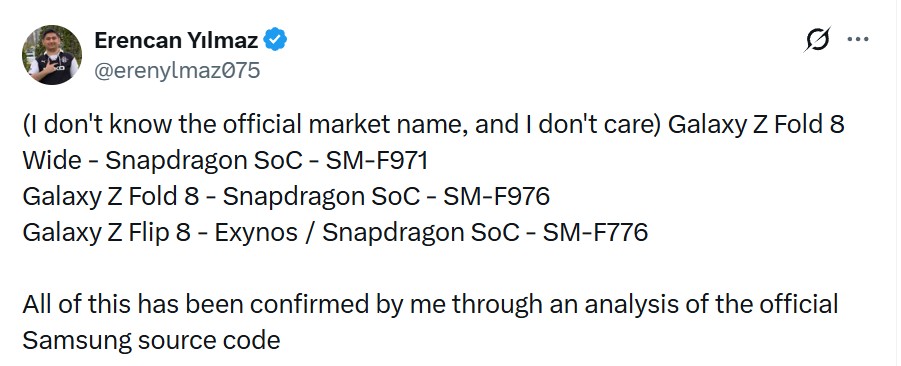
5. The Leak Comes from Samsung's Own Code—Here's How We Know
These insights aren't just rumors. They stem from a code analysis conducted by tipster Erencan Yılmaz, who shared findings on X (formerly Twitter). The code, sourced from Samsung's internal systems, clearly references multiple chip configurations for the upcoming foldable models. While companies often test multiple options during development, the consistency of the pattern—Snapdragon for Fold, mixed for Flip—suggests a deliberate shift rather than mere experimentation. This kind of leak, based on actual firmware or developer files, is typically reliable for revealing manufacturer plans, as it comes from Samsung's own engineering databases. Combined with last year's move to put Exynos in the Galaxy Z Flip 7 and Flip 7 FE, the code evidence strengthens the case that Samsung is committed to a divided chip strategy for its foldables going forward.
In conclusion, Samsung's foldable chip strategy is undergoing its biggest transformation since the launch of the original Galaxy Fold. By splitting the Snapdragon and Exynos assignments between the Z Fold and Z Flip lines, and by introducing regional variations, Samsung is aiming for greater flexibility and cost control. For consumers, this means the chip inside your next foldable will depend more than ever on which model you choose and where you buy it. While the Z Fold 8 remains a Snapdragon stronghold, the Z Flip 8 could test the waters with Exynos—potentially offering lower prices or different battery performance. As we await official announcements, this insider leak gives us the clearest picture yet of what to expect. Keep an eye on Samsung's launch events for the final confirmation, and consider your regional availability before pre-ordering.
Related Articles
- Why I Stopped Disabling This Hidden Windows Performance Booster
- Mac Mini's Entry-Level Storage Bumped to 512GB: What You Need to Know
- Decoding Apple's Earnings: How iPhone Revenue Hit $57B Amid Chip Supply Woes
- Acer Predator Helios Neo 16S AI Deal: RTX 5070 Ti, OLED, and 32GB RAM for Under $1,800
- Navigating Supply Chain Disruptions: A Guide to Apple’s Record iPhone Revenue
- Anthropic in Talks to Acquire Next-Gen AI Chips from UK Startup Fractile Amid Memory Crunch
- Rust 1.97 to Drop Support for Older NVIDIA GPUs and CUDA Drivers
- The Complete Guide to Matching Transistors for Reliable Circuits