Breaking Free: How Meta Overhauled WebRTC for 50+ Applications
Meta relies on real-time communication (RTC) for services like Messenger, Instagram video calls, cloud gaming, and VR casting on Meta Quest. For years, they maintained a heavily customized fork of the open-source WebRTC library to meet performance demands across billions of users. However, this fork gradually diverged from upstream, creating a classic “forking trap.” To escape it, Meta engineered a modular architecture that allows two WebRTC versions to coexist for safe A/B testing while continuously integrating upstream updates. This article explores their journey, the challenges, and the solutions that now keep their RTC stack modern and efficient.
- What is the “forking trap” and why is it dangerous?
- Why did Meta need to replace their WebRTC fork?
- How did Meta solve the problem of linking two WebRTC versions in one app?
- What is the dual-stack architecture and how does it enable A/B testing?
- How does Meta perform continuous upgrades with A/B testing?
- What improvements did Meta achieve after modernizing WebRTC?
What is the “forking trap” and why is it dangerous?
When a company forks a large open-source project like WebRTC, it often starts with good intentions: a quick bug fix or a specialized optimization. Over time, however, the internal fork accumulates custom features and quick patches while the upstream project continues to evolve independently. The effort required to merge upstream changes back into the fork grows exponentially—engineers must resolve conflicts, adapt new APIs, and ensure compatibility. Eventually, the fork becomes so divergent that merging is prohibitively expensive, cutting the company off from community improvements, security patches, and performance enhancements. This situation is known as the “forking trap.” The trap leads to technical debt, increased maintenance costs, and a widening gap between the internal version and the community standard. Meta recognized this risk and decided to break the cycle by moving to a modular, upgrade-friendly architecture.
Why did Meta need to replace their WebRTC fork?
Meta’s WebRTC fork powered real-time features across more than 50 use cases, including Messenger and Instagram video chats, cloud gaming, and VR casting. As the fork drifted from upstream, Meta missed out on important community advancements—better codecs, security fixes, and performance optimizations. At the same time, the sheer scale of Meta’s user base (billions of people) meant that any upgrade carried high risk: a regression could degrade experience on countless devices. A one-time migration was too risky because rollbacks would be difficult. Meta needed a way to test new versions safely alongside the old one, verifying that proprietary features still worked and that performance didn’t suffer. This required a radical rethinking of how WebRTC was integrated into their monolithic repository. The solution had to allow two versions of the library to coexist in the same app, enabling controlled experiments before full rollout.
How did Meta solve the problem of linking two WebRTC versions in one app?
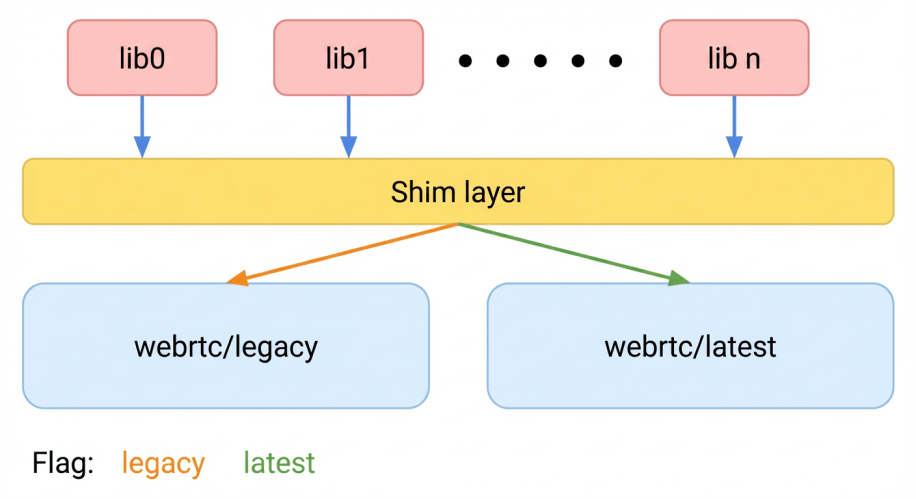
Linking two versions of the same C++ library in a single binary violates the One Definition Rule (ODR), causing thousands of symbol collisions. Meta’s monolithic repository build system further complicated matters. Their solution was to build a modular architecture where upstream WebRTC serves as a skeleton, while Meta’s proprietary components (codecs, network logic, etc.) are implemented as separate modules that plug into it. They used static linking but with careful namespace and symbol hiding techniques to avoid ODR violations. Specifically, they compiled upstream WebRTC with a unique namespace prefix and applied visibility attributes to internal symbols. The proprietary modules were compiled against this custom build, and both versions (legacy fork and new upstream-based stack) could be linked into the same executable. This dual-image approach allowed Meta to dynamically switch between the two at runtime, enabling seamless A/B testing without rebuilding the entire application.
What is the dual-stack architecture and how does it enable A/B testing?
The dual-stack architecture is the core of Meta’s strategy. It consists of two complete implementations of WebRTC: one is the old, heavily patched fork; the other is built on the latest upstream version with Meta’s proprietary components layered on top. Both stacks are statically linked into the same library, but they are isolated through namespace and compile-time flags. At runtime, Meta’s feature flag system can assign individual users to either stack—without requiring an app update. This is critical for safe A/B testing across diverse devices and network conditions. Engineers can compare metrics like call setup time, audio/video quality, CPU usage, and crash rates between the two stacks. The dual-stack approach also enables gradual rollback: if the new stack introduces a regression, Meta can instantly revert users to the legacy stack. Over time, as the new stack proves stable, the legacy fork is retired, and the architecture simplifies again.
How does Meta perform continuous upgrades with A/B testing?
Meta no longer stays on a single version of WebRTC for years. Instead, they treat each new upstream release as a candidate for evaluation. Using the dual-stack architecture, they build a fresh version of their proprietary elements against the latest upstream WebRTC. This new stack is then A/B tested against the current stable version across a small percentage of users. Metrics are collected automatically, and if regressions appear, engineers can pinpoint them to specific upstream changes. Once the new stack meets stringent quality bars, it is gradually rolled out to more users. This continuous upgrade cycle means Meta always runs on a relatively recent upstream base, benefiting from community improvements while retaining their custom code. The process eliminates the painful merge and conflict resolution that plagued the old fork. Today, every WebRTC release goes through this pipeline, ensuring Meta’s RTC infrastructure stays modern and resilient.
What improvements did Meta achieve after modernizing WebRTC?
The migration to the modular, continuously upgraded WebRTC stack delivered significant benefits across three key areas: performance, binary size, and security. Performance improved because Meta could adopt upstream optimizations—better video codecs, more efficient network handling, and lower latency algorithms—without waiting for custom backports. Binary size was reduced because the new architecture allowed Meta to strip out unused legacy code and selectively include only the components they needed. Security also improved dramatically: with every upstream release, Meta automatically receives the latest vulnerability patches, closing holes that might have lingered in the old fork. Furthermore, the ability to A/B test each release means new features are validated before broad deployment, reducing the risk of regressions. Meta continues to use this approach today, with all 50+ use cases running on a modern, well-maintained WebRTC foundation.
Related Articles
- Git 2.54 Streamlines History Editing with the New `git history` Command
- Rust's Google Summer of Code 2026: A New Wave of Open Source Contributions
- Navigating Age Assurance Laws: A Developer's Practical Guide
- GitHub Revamps Copilot Plans with Flex Allotments, Launches New Max Tier
- 8 Key Insights into the Kubernetes AI Gateway Working Group
- How to Successfully Change Your Open Source Project's License
- Lifetime Subscriptions Under Scrutiny: Plex, Google's AI Push, and the Trump Phone Rumor
- Transparent Arm Virtual Machines on s390: A Q&A on Hardware-Assisted Emulation